
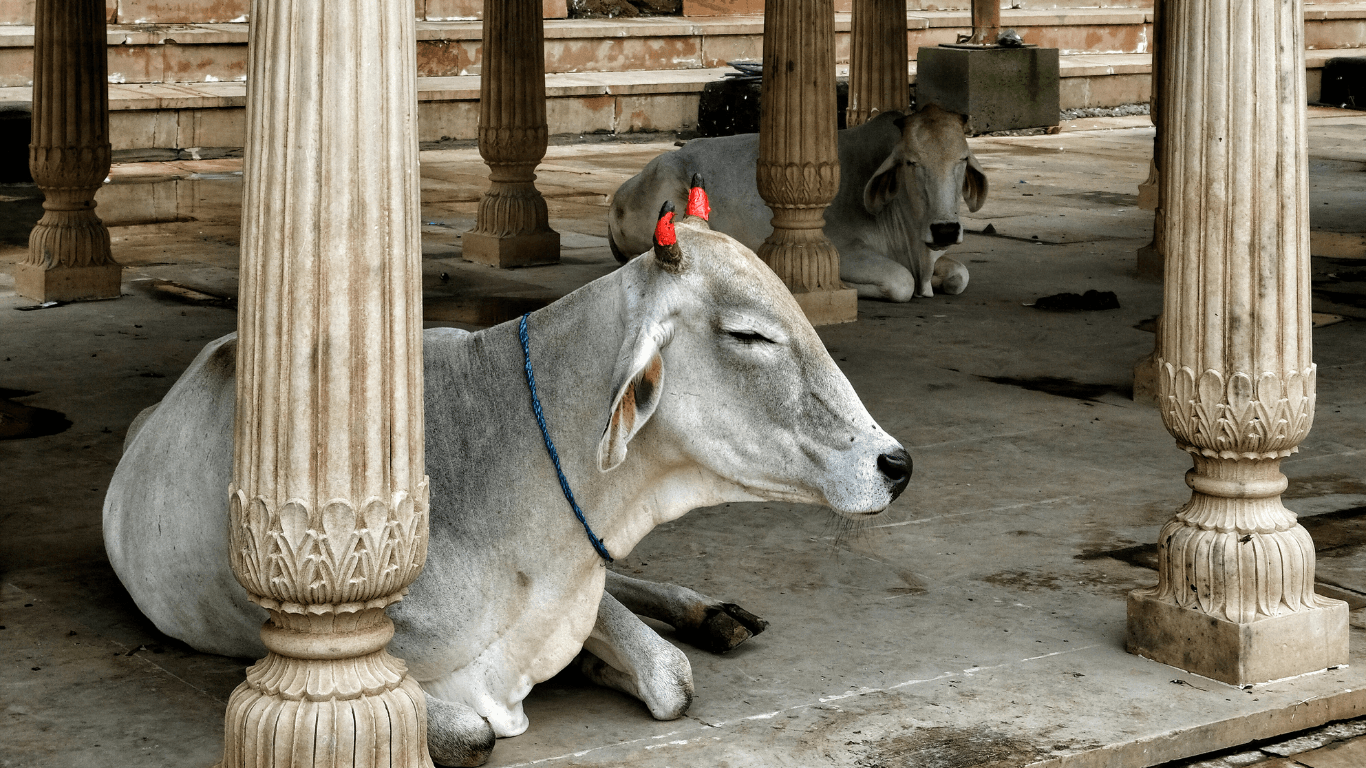
If you travel to India, sooner or later, you will be surprised to see cows in India walking quietly among cars, temples and markets, oblivious to the chaos and bustle. For millions of Indians, the cow is not just an animal: it is a mother, a protector, a living symbol of abundance and spirituality. This veneration is not a fad or a passing custom, but an ancient tradition deeply rooted in the heart of Indian culture.
In this article I will tell you why cows are sacred in Indiaits significance in the HinduismThe role they play in everyday life, and we will even talk about the sanctuaries that protect them 🐮.
The sacred cow: a link to the divine
When talking about the sacred cow in Indiawe are talking about "Gau Mata"Mother Cow. In Hinduism, the cow is seen as a maternal being who nourishes with her milk, just as Mother Earth nourishes and protects all living beings. This deep respect is already mentioned in the Vedic texts, where the cow symbolizes purity, generosity and life.
But why are cows sacred in India?
The answer is found in ancient Vedic texts and Hindu mythology. Krishna, the god of love and compassion, was a cowherd in his childhood, and many stories show him playing the flute while cows surround him. Kamadhenu, the celestial cow, is considered the "mother of all cows" and represents prosperity and abundance. This spiritual connection has made cows a symbol of respect and gratitude for life.
Sacred cow: meaning and presence in daily life
The meaning of the sacred cow goes far beyond religion. In towns and villages, cows are the heart of the family economy. Their milk, ghee (clarified butter), yogurt and other derivatives are fundamental in Hindu cooking and rituals. Even manure and urine are used as fertilizers, disinfectants and natural fuels, showing how every part of this animal is valuable.
The sacred cows in India are also the reflection of a philosophy called ahimsaThe principle of non-violence towards any living being. This value, present in Hinduism, Buddhism and Jainism, teaches respect for all forms of life.
Do they eat beef in India?
One of the most common doubts among travelers is whether to in India they eat beef. Most Hindus do not, because they consider the cow a sacred being. In many states it is forbidden to slaughter or sell beef, and doing so may be considered a crime.
However, in regions where other religions predominate, such as Muslim or Christian communities, beef can be found, although it is not as common as chicken, fish or lamb.
Name of the sacred cow in India
In the Hindu tradition, the cow is known as the "Gau Mata"which means "Mother Cow". This name encloses an affective and spiritual relationship, as she is considered a member of the family, a protector who nourishes and cares.
Cows in India: between tradition and modernity
See cows in India walking freely through the streets, resting on the sidewalks or crossing roads is part of everyday life. For Indians, letting a cow pass or feeding it with fruits or chapatis is a gesture of respect and devotion.
However, modernity poses new challenges. Urban traffic, pollution and the expansion of cities have increased the risks for cows living in the wild. In response to this problem, special sanctuaries and shelters have emerged.
Cow sanctuaries in India:
To protect these animals, the following have been created gaushalasThe shelters are intended for the care of sacred cows. These places provide food, veterinary care and a safe environment for abandoned or injured cows. Many gaushalas are financed by donations from the faithful and temples, since caring for a cow is considered an act of spiritual merit.
These sanctuaries not only ensure the welfare of the cows, but also promote sustainable practices such as the production of biogas or ecological fertilizers from organic waste.
Cow sanctuaries in India
1. Hingonia Gaushala (Jaipur, Rajasthan)
It is one of the largest refuges in the world, taking care of more than 19,000 cows and bulls. There, injured animals are rescued, given medical attention and a dignified life. It also produces energy from biogas, generating self-sufficiency.
2. Shri Mataji Gaushala (Barsana, Uttar Pradesh)
This cow sanctuary in India protects more than 55,000 cowsand functions as a hospital, shelter and eco-innovation center. Its founder, Ramesh Babaji Maharaj, is a highly respected figure in the country.
3. Radha Surabhi Gaushala (Mathura, Uttar Pradesh)
Run by Sudevi Mataji, a Padma Shri award-winning German, this cow shelter in India cares for more than 1,800 cows and orphans, offering medical care and adapted spaces.
The sacred cow, a timeless symbol
The sacred cow in India is much more than a religious symbol; it is the representation of a culture that honors life in all its forms. When you see a cow on the streets of Delhi, Varanasi or Jaipur, you are not just seeing an animal, but a being revered as a mother, protector and giver of life.
Traveling in India is to learn to see the world with new eyes, to respect nature and to appreciate the deep spiritual connection that lies behind everyday gestures such as feeding a cow. In her calm gaze there is a silent lesson: to live in harmony with everything around us.
Hopefully this article will help you understand the importance of cows in India🐮 and their more spiritual and human significance.

Leave a Reply