
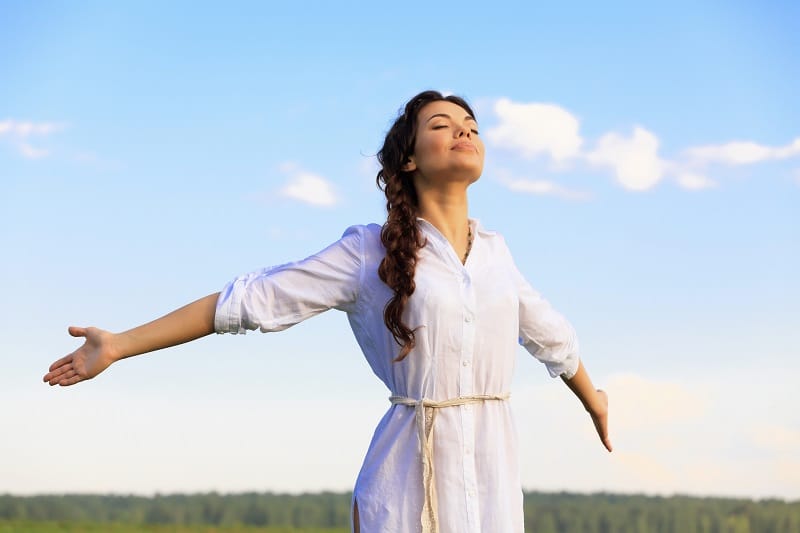
The breathing is the most vital activity of our organism but no one teaches us how to do it correctly, nor do we ourselves take the time to learn how to breathe.
We can survive several days without eating and a few days without drinking, but we can barely last 2 minutes without breathing. Nowadays we give great importance to the quality of everything we eat but we don't pay attention to the quality of the air and the way we breathe. But all is not lost and it is never too late, so if you want to live a healthier life, this is your time to to learn to breathe!
Our society needs to learn to breathe
Despite the fact that breathing is an activity that we do continuously and unceasingly throughout our lives, most of the population breathes poorly and does not even take advantage of the 30% of its lung capacity. In this way the amount of oxygen we provide to the body is reduced to one third. for their vital functions, causing a bad oxygenation of our tissues that can derive in digestive problems, nervous system problems, fatigue, muscle discomfort, lack of concentration, and anxiety among many others.
The first thing we do at birth is breathe, and despite our lack of experience, we do it correctly. As the years go by "we unlearn" and compromise our breathing due to many social factors such as stress, emotional flows, the pace of life we lead, tight clothes, to be much of our day sitting in a posture not conducive to full breathing and lack of time that invites us to breathe in a hurry.
Fortunately, in recent years the respiration is taking an important place in medical treatments in the West. There is an increasing number of scientific studies on the importance of long, deep breathing and there has been a growing interest in Eastern breathing techniques that encourage subtle breathing.

How do you breathe?
Breathing can be a involuntary or voluntary process. It is considered an involuntary activity since it does not require conscious attention and happens by itself but we are lucky (those who know how to take advantage of it) that this activity can become voluntary and therefore, conscious. I will explain in more detail:
- Involuntary and unconscious breathing: the act of breathing happens without us altering its process and without us becoming aware of this action.
- Voluntary and conscious breathing (you observe it as you do it): we enter into the act of breathing and we can modify its pattern by being aware of this process.
- Involuntary and conscious breathing (you observe it without doing it): Breathing happens as an automatic process without us modifying it, but in this case we are conscious and present in this action.
Voluntary and conscious breathing is the type of breathing that we should start practicing to create correct patterns and that with time and a lot of practice will become automatic and we will start observing our breathing without participating in it voluntarily.
Learning to breathe consciously
Conscious breathing is basically to concentrate fully on the process of our breathing and make long, deep and subtle inhalations and exhalations (not forced or erratic). Feeling and enjoying the path of the air from the moment it enters until it leaves through the nose and discovering the sensations it provokes in our physical body and in our mind.
Let's start practicing:
- Start by preparing a comfortable area for your practice where you can relax.
- Lie down, relax your body and place one hand on your abdomen and the other hand on your chest (both without pressing).
- Breathe in slowly and deeply, feeling our abdomen swell (as a result of the diaphragm movement) and then (to a lesser extent) the chest area followed by a slight elevation of the clavicular area.
- Breathe out slowly and feel the process of exhaling in reverse, first emptying the clavicular area, followed by the thoracic area and finally the abdominal area.
- We will start with cycles of the same time to inhale and exhale (within your comfort zone), so if you take 4 times to inhale you will also take 4 times to exhale (the times should be adapted to your breathing capacity). Both inhalations and exhalations must be done gradually and continuously.
- Repeat 2 times the cycle of 20 full breaths. Remember that this breathing should be deep and continuous as well as subtle and relaxing.
Benefits of conscious, long, deep breathing
- Increases lung capacity
- Generates tranquility and peace of mind by reducing stress and anxiety.
- Improves the state of the nervous system
- Improves concentration
- Promotes serenity and helps to channel emotions
- Improves digestion
- Take care of your heart
- Decreases the sensation of pain
- Eliminates toxins from the blood
- Improves circulation
I recommend you read my article on : "Pranayama to get you started in this ancestral practice of India that can improve your breathing and your health in general.
Important warning: These wellness techniques should be practiced under the supervision of a qualified professional, adapting them to individual needs and capabilities. This content is for informational purposes only and is not a substitute for professional advice. Before beginning any practice, consult with a certified instructor or health professional, especially if you have pre-existing medical conditions.

Leave a Reply